How to Track Bitcoin Supply Issued Per Day (Beyond Halving Narratives)

Most Bitcoin discussions focus heavily on price movements or halving countdowns. While halvings are important, they are not the full story. Bitcoin’s supply dynamics operate every single day, block by block, regardless of market sentiment. Understanding how much Bitcoin is issued daily, and where existing supply actually resides, offers a far clearer picture of scarcity than a simple countdown timer ever could.
This guide shows how to visually track Bitcoin’s supply and daily issuance using a dedicated supply visualization tool, without relying on charts, trading platforms, or block explorers.
Step 1: Open the Bitcoin Supply Visualization Page
Start by visiting the Bitcoin Supply – Visualized page on blockchaincenter.net.
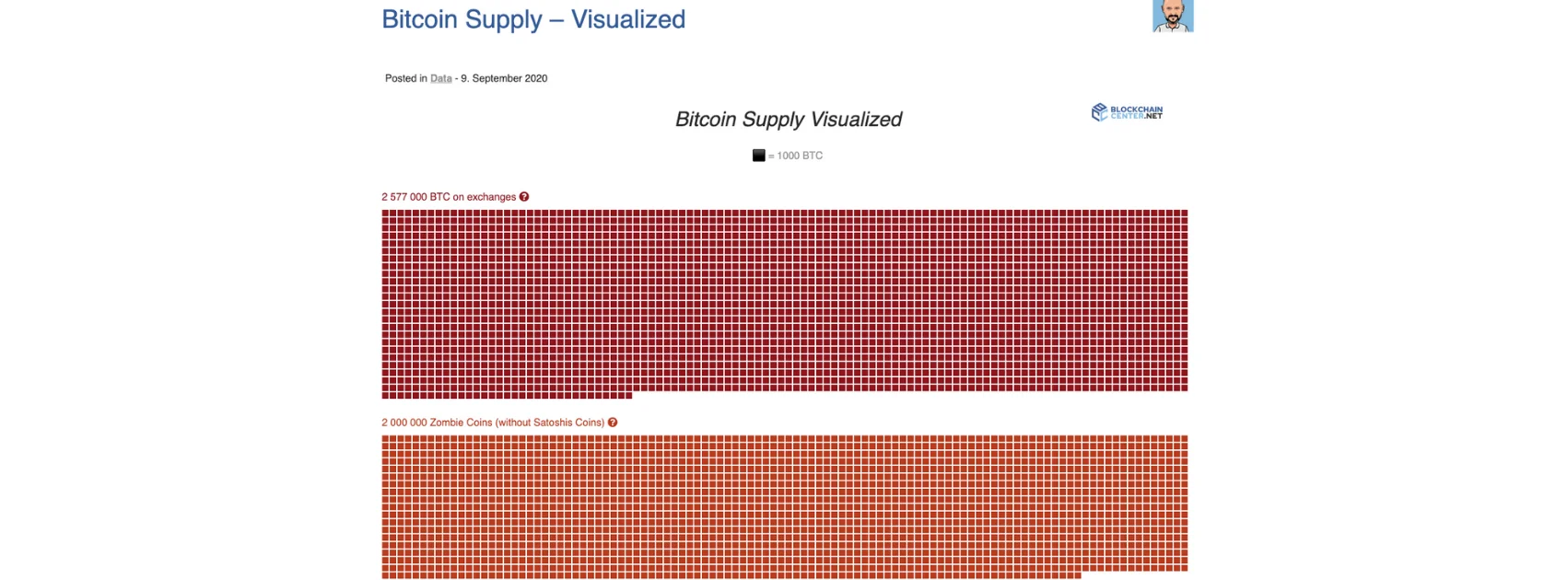
Once the page loads, you are presented with a large visual grid. Each small square represents 1,000 BTC, and each color corresponds to a different category of Bitcoin supply. This is not a price chart and not a prediction model. It is a snapshot of how Bitcoin’s total supply is distributed across the ecosystem.
At a glance, this view immediately shifts your perspective from “How much is Bitcoin worth?” to “How much Bitcoin is actually available?”
Step 2: Understand Where Existing Bitcoin Supply Sits
Scrolling down the page reveals labeled sections that categorize Bitcoin supply into real-world groupings, such as Bitcoin held on exchanges, long-lost coins (often referred to as zombie coins), institutional holdings, seized coins, and historically significant allocations.
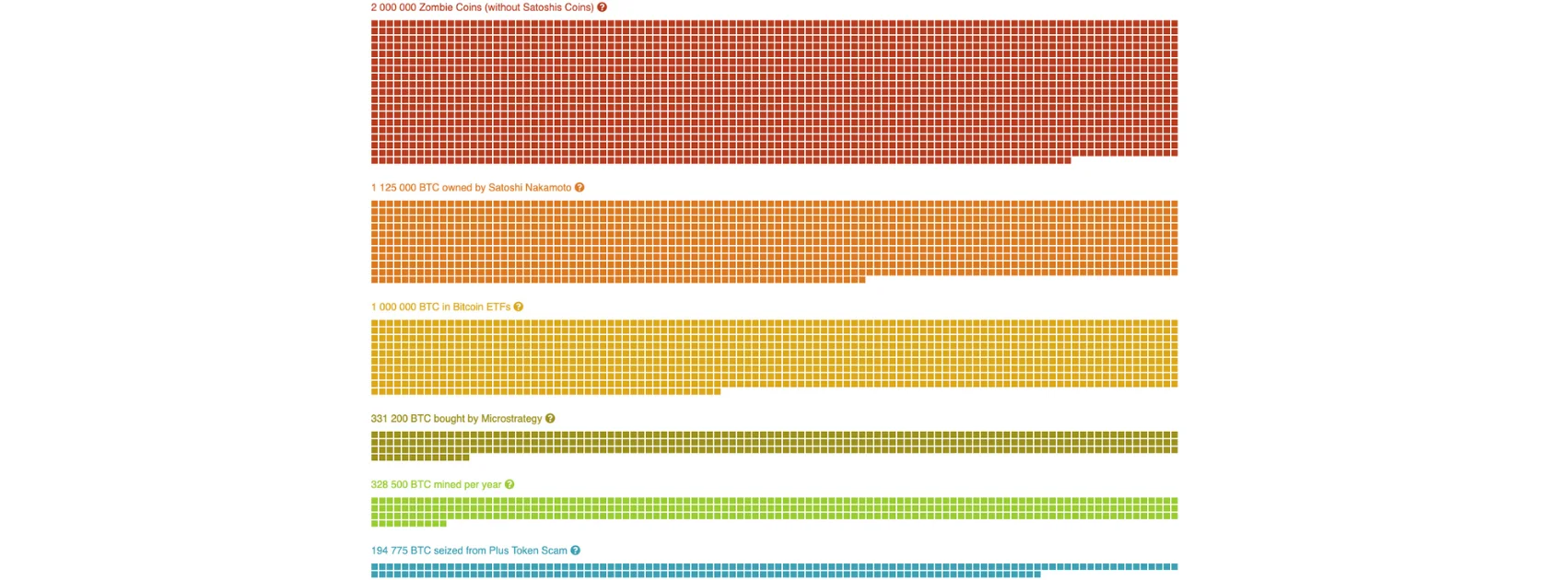
Each category is represented visually, making it easy to grasp scale without reading tables or raw numbers. This step is critical because it highlights an often-missed reality: not all mined Bitcoin is liquid, tradable, or economically active.
By seeing supply broken down visually, you can quickly understand why scarcity is not just about the total cap of 21 million, but about how much Bitcoin is realistically accessible at any given time.
Step 3: Locate the “BTC Mined Per Year” Section
Continue scrolling until you find the section labeled “328,500 BTC mined per year.”
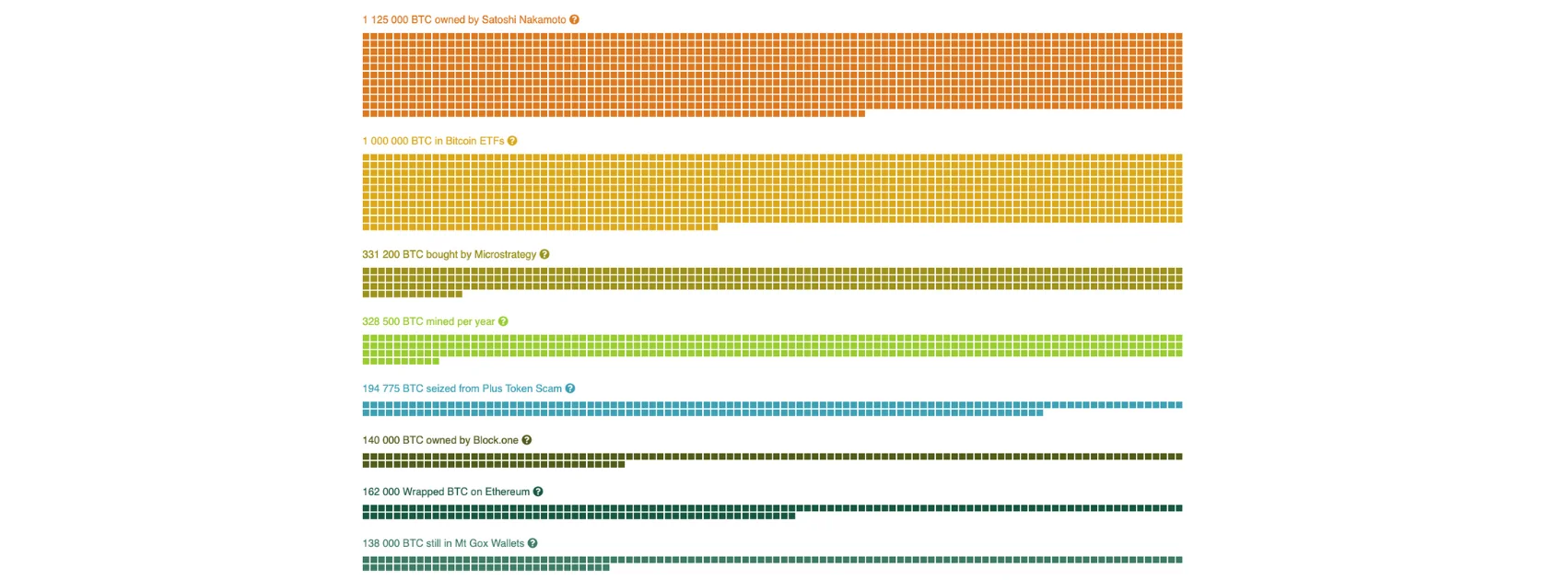
This row represents the current rate at which new Bitcoin enters circulation under the present block reward. Unlike halving countdowns, this figure reflects Bitcoin’s ongoing issuance in real time, not a future event.
To translate this into daily issuance, divide the yearly figure by 365. This results in approximately 900 BTC issued per day.
This number is the true heartbeat of Bitcoin’s monetary expansion. Every day, regardless of market conditions, roughly 900 new Bitcoin are introduced into the system until the next halving reduces that rate.
In addition, if you would like to learn How To View Bitcoin on a Logarithmic (Log) Chart, check it out on the Bitcoin Everlight education center.
Why Tracking Daily Bitcoin Issuance Matters
Daily issuance is the mechanism that applies constant supply pressure to the market. While halvings reduce this pressure periodically, they do not eliminate it. Understanding how much Bitcoin is issued each day allows you to think in terms of flow, not hype.
This perspective helps explain why scarcity develops gradually, why supply shocks take time to manifest, and why Bitcoin’s monetary policy is better understood as a slow, predictable process rather than a series of sudden events.
By focusing on issuance instead of countdowns, you gain a more realistic view of Bitcoin’s long-term supply behavior and its implications for adoption, liquidity, and valuation.
Conclusion
Bitcoin’s strength lies in its transparency and predictability. Tracking how much Bitcoin is issued per day, and where existing supply actually resides, provides a grounded understanding of scarcity that price charts and halving timers cannot offer on their own.
Visualizing supply distribution and daily issuance helps cut through noise and reinforces Bitcoin’s role as a system governed by rules, not narratives. For anyone seeking a deeper understanding of Bitcoin beyond speculation, this perspective is essential.