How to Track Bitcoin Whale Activity Using Live Data

Most people only look at Bitcoin’s price, but by the time price moves, the real action has already happened.
Behind every major rally or crash, there are large players quietly moving massive amounts of money. These are known as “whales,” and their transactions can reveal early signals about where the market might be heading next. The problem is that most people never see this activity, or they don’t know how to interpret it.
In this guide, you’ll learn how to track Bitcoin whale movements in real time using Whale Alert, and more importantly, how to understand what those movements actually mean for the market.
Step 1: Go to Whale Alert
Open the Whale Alert dashboard. This is where you can track large crypto transactions in real time across multiple blockchains.
Step 2: Analyze Live Whale Transactions
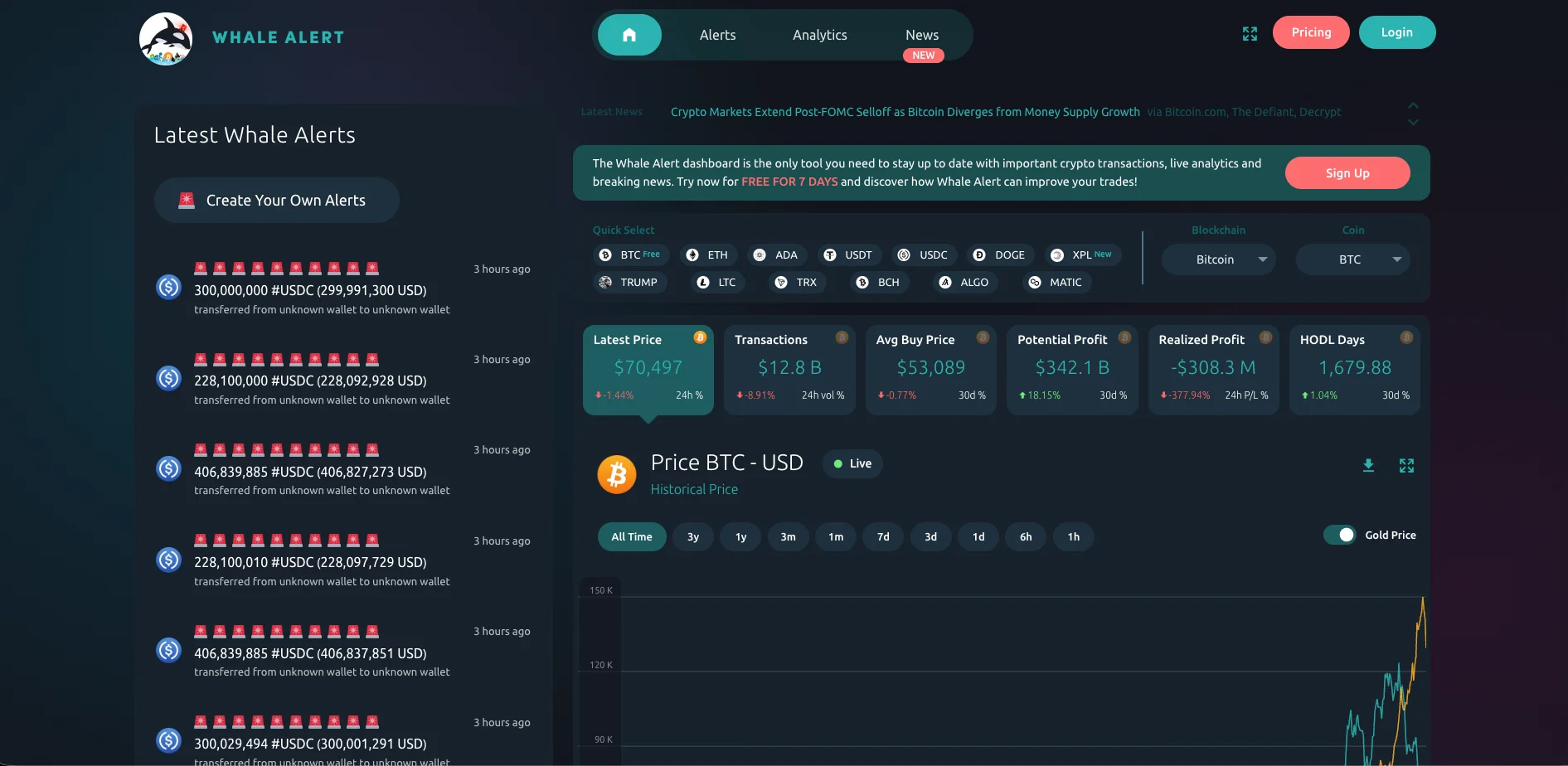
As soon as you enter the dashboard, you’ll see a feed labeled “Latest Whale Alerts.” This is the most important section.
Each alert shows massive transactions like hundreds of millions of dollars moving between wallets. In your screenshot, you can see repeated transfers of hundreds of millions in USDC, often labeled as moving from “unknown wallet to unknown wallet.”
This is where things get interesting.
When large amounts move:
It could mean institutions repositioning funds
It could signal upcoming buying or selling pressure
It could reflect liquidity shifts across exchanges or OTC desks
On the right side of the dashboard, you also get supporting context:
BTC price
Total transactions volume
Average buy price
Profit/loss metrics
HODL days
This combination matters. You’re not just seeing movement—you’re seeing it in context.
For example, if whales are moving large funds while price is dropping, that could signal distribution. If they’re moving funds off exchanges during fear, that often signals accumulation.
In addition, if you would like to learn How to Track Bitcoin Hashrate Growth to Measure Network Security, check it out on the bitcoin everlight education section
Why This Matters
Most people react to price. Smart money moves before price.
Whale activity gives you a glimpse into what large players are doing behind the scenes. These are not random traders, these are institutions, funds, and early adopters moving serious capital.
But here’s the key: not every whale move means something bullish or bearish. You need to combine this with context. Is the market in fear? Are funds moving into exchanges or out of them? Are these repetitive patterns or one-off events?
When you start reading this correctly, you stop reacting—and start anticipating.
Conclusion
Tracking whale activity won’t make you instantly predict the market, but it changes how you see it. Instead of following noise, you begin watching the players who actually move the market.
Over time, you’ll notice patterns—when whales accumulate, when they distribute, and when they simply reposition. That awareness alone puts you ahead of most people who are only watching price charts.
Because in Bitcoin, the biggest moves don’t start on the chart—they start with the whales.